 Français
 Nederlands
 English
Buying a used car in Belgium is risky without the right tools. An OBD2 scanner lets you see, in 5 minutes, what the seller might be hiding — recently cleared fault codes, engine mileage, hidden problems. Here's the complete guide.
Contents
Why use an OBD2 for a used car purchase?
Unscrupulous sellers clear fault codes before a sale to hide problems. But OBD2 reveals far more than just active codes:
- Active fault codes — current unresolved problems
- Pending codes — problems detected but not yet confirmed
- Recently cleared codes — a "freeze frame" showing the conditions at the last fault
- Incomplete OBD monitors — a sign the codes have recently been cleared
The OBD2 checklist before buying a used car
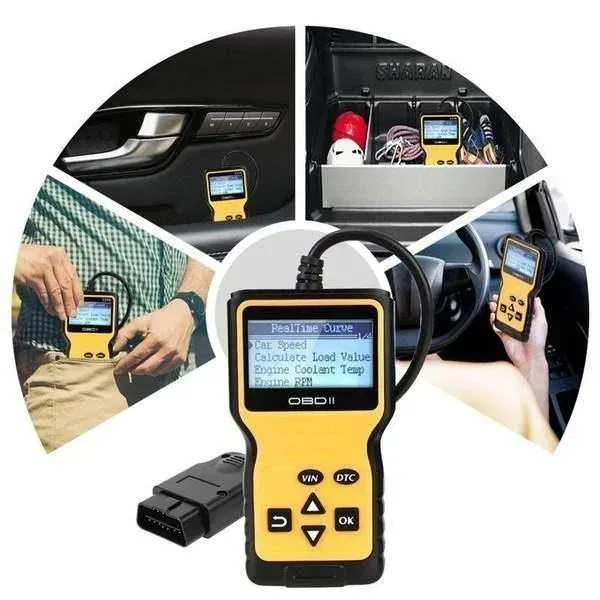
With the ignition off, you can already read the codes. Check that there's no active code.
Let the engine warm up. Re-check the codes — some only appear when the engine is hot.
Navigate to "Monitor status" or "Test results". They should all be "Complete". If several are "Incomplete" → codes have recently been cleared.
Coolant temperature, MAP, RPM, oxygen sensor. Everything should be stable and within normal ranges.
Some vehicles store the actual mileage in the ECU — even if the odometer has been tampered with.
Deal-breaker OBD2 codes when buying
- 🔴 P0300-P0308 — Misfires: the engine needs a thorough check
- 🔴 P0420/P0430 — Dead catalytic converter: €200-800 to repair
- 🔴 U0100+ — CAN network problem: ECU or wiring harness
- 🔴 P0340/P0343 — Camshaft sensor: risk of the car not starting
- 🟡 P0171/P0174 — Lean mixture: worth investigating (sensor, air leak)
- 🟢 P0442 — Small EVAP leak: fuel cap, inexpensive fix
Other checks to combine with OBD2
- Check the service record (timing belt done?)
- Check the CarPass (official mileage history in Belgium)
- Visual inspection (rust, scratches, signs of a past accident)
- Test drive with firm acceleration
CarPass: an essential complement to the OBD2 diagnostic
In Belgium, the CarPass is an official, free document that traces a vehicle's mileage history, recorded at every roadworthiness test, service, or sale by a professional. It helps spot a tampered odometer — a fraud that remains common on the used car market. A private seller is legally required to hand over the CarPass at the time of sale; if they refuse or delay providing it, that's a red flag to take very seriously.
The OBD2 scanner and the CarPass complement each other: the CarPass validates the official mileage history, while the scanner reveals the actual mechanical condition at the precise moment of your visit — together they give a far more reliable picture than either tool used on its own.
Using the diagnostic to negotiate the price
Beyond spotting a deal-breaker, a clean OBD2 diagnostic is also a negotiating tool in both directions. If the check reveals a minor, easily fixed code (a small EVAP leak, a cheap sensor), you can reasonably ask for a discount matching the cost of the part and labour. Conversely, a completely clean diagnostic with every monitor "complete" is a reassuring argument if you're the one having to justify your asking price as a seller.
FAQ — Checking a used car with OBD2
Can the seller refuse to let me plug in an OBD2 scanner?
A serious seller has no reason to refuse an OBD2 check, which only takes a few minutes and doesn't damage the vehicle in any way. An outright refusal should raise suspicion.
Does an OBD2 diagnostic replace a roadworthiness test or a professional inspection?
No, it's a quick, free first filter before buying, but it doesn't replace a full mechanical inspection by a professional for a major purchase, nor the mandatory official roadworthiness test.
What should you do if the scanner can't connect to the seller's vehicle?
First check that the ignition is properly on and that the OBD2 port isn't damaged or deliberately hidden. An OBD2 port that's hard to access or visibly tampered with on a recent vehicle is itself a negative sign.
🚗 Buy your used car with confidence
OBD2 scanner — the most cost-effective investment before any used car purchase