 Français
 Nederlands
 English
Your engine light has come on? Your car is using more fuel than usual? Before paying €80-150 at the garage just for a diagnostic, know that you can do it yourself in under 5 minutes with an OBD2 scanner. This guide explains everything.
Contents
What is OBD2?
OBD2 stands for On-Board Diagnostics 2 — it's your car's built-in diagnostic system. All the sensors in your vehicle (engine, transmission, ABS, airbags...) communicate through this standardised interface.
The OBD2 port is usually located under the dashboard on the driver's side, within 60 cm of the steering wheel. It's always accessible without any tools.
Which OBD2 scanner should you choose?
There are 3 types of scanners depending on your needs:
1. Wired scanner with built-in screen
Ideal for standalone use with no smartphone needed. Plug in the cable, the LCD screen displays fault codes directly. No app required. It's the most reliable option for beginners.
2. Bluetooth scanner (via smartphone)
Connects to your phone via Bluetooth. Requires an iOS or Android app. More graphical features, but depends on compatibility with your phone.
3. Professional multi-brand scanner
For advanced functions: ABS, airbags, transmission, service reset. Recommended for enthusiasts or experienced amateur mechanics.
🔧 Discover our OBD2 scanners
From basic wired models to multi-brand pro scanners — free delivery to Belgium
How to use an OBD2 scanner — step-by-step guide
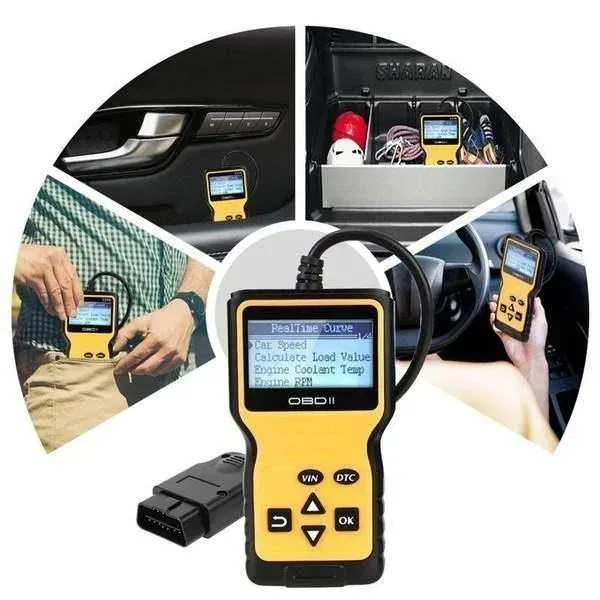
Under the dashboard, on the driver's side. Look for a trapezoid-shaped 16-pin socket.
Connector facing down, insert firmly until it clicks. Do not force it.
Turn the key to the "ignition" position (without starting the engine). The scanner switches on automatically.
Navigate the menu → "Read DTC codes". The scanner displays every code present.
Note down the codes (e.g. P0300) and check our table below to understand what they mean.
After the repair, use the "Clear codes" function to turn off the engine light.
The most common OBD2 codes in Belgium
| Code | Meaning | Severity |
|---|---|---|
| P0300 | Multiple cylinder misfire | ⚠️ Moderate |
| P0171 | System too lean — Bank 1 | ⚠️ Moderate |
| P0420 | Catalyst system efficiency below threshold | 🔴 Serious |
| P0442 | EVAP system leak detected | 🟡 Minor |
| P0500 | Vehicle speed sensor — faulty signal | ⚠️ Moderate |
| P0113 | IAT sensor — signal too high | 🟡 Minor |
| P0340 | Camshaft position sensor | 🔴 Serious |
| P0128 | Thermostat — insufficient temperature | ⚠️ Moderate |
OBD2 vs Garage: how much do you save?
A diagnostic at a garage costs between €80 and €150 in Belgium. With an OBD2 scanner at €34.99, you recoup your investment from the very first diagnostic.
Plus, you can:
- Monitor your car in real time
- Avoid unnecessary "padded" diagnostic fees
- Catch problems before they become breakdowns
- Check the condition of a used car before buying it
Compatibility: does OBD2 work on my car?
Yes, if your car is:
- A European petrol or diesel vehicle from 2001 onwards
- An American vehicle from 1996 onwards
- Any make: BMW, Audi, VW, Peugeot, Renault, Mercedes, Ford, Toyota, Citroën, Opel, Seat, Skoda...
🛒 Ready to diagnose your car?
OBD2 scanners — free delivery to Belgium, France, Luxembourg
Frequently asked questions
Does an OBD2 scanner damage the car's electronics?
No. The scanner is read-only by default. It doesn't change any settings on your vehicle — it simply reads information that's already there.
Can an OBD2 scanner be used on a hybrid or electric vehicle?
Yes for hybrids. Fully electric vehicles often use different protocols — check compatibility before buying.
Do you need to be a mechanic to use an OBD2 scanner?
Not at all. Our scanners are designed for everyday drivers, with clear menus, straightforward explanations and an immediate learning curve.