 Français
 Nederlands
 English
OBD1, OBD2, EOBD... Are these acronyms confusing you? Here's a clear explanation of the differences between these diagnostic systems and how to check whether your car is OBD2-compatible.
Contents
- OBD1 — The first diagnostic system (1980-1996)
- OBD2 — The universal standard (1996/2001 → today)
- EOBD — The European version of OBD2
- How do I know if my car is OBD2?
- OBD2 vs CAN Bus — what's the difference?
- OBD2 on hybrid and electric cars
- The 5 OBD2 communication protocols
- What OBD2 can't do
- What comes after OBD2? Towards OBD3
- FAQ — OBD1 vs OBD2
OBD1 — The first diagnostic system (1980-1996)
OBD1 (On-Board Diagnostics 1) was a proprietary system — every manufacturer had its own protocol and its own port. To read the codes on an OBD1 vehicle, you needed a tool specific to that make (a Renault tool wouldn't work on a Peugeot).
- No standardised port
- Different protocols depending on the make
- Little information available
- Used on vehicles before 1996 (US) / 2001 (Europe)
OBD2 — The universal standard (1996/2001 → today)
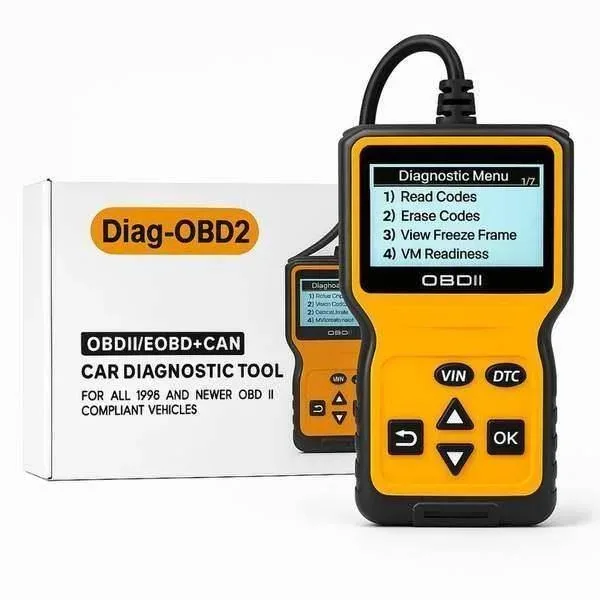
OBD2 changed everything: a standardised universal port, common protocols, and a scanner that works across every make. This is the system our Diag-OBD2 scanners read.
United States: 1996 (all petrol vehicles)
Europe petrol: 2001
Europe diesel: 2004
🌍 Worldwide: most countries since 2005-2010
EOBD — The European version of OBD2
EOBD (European OBD) is simply the European name for the OBD2 standard. There's no technical difference — an OBD2 scanner reads EOBD vehicles and vice versa.
How do I know if my car is OBD2?
- Method 1: Look for a trapezoid-shaped 16-pin port under the dashboard → that's OBD2
- Method 2: Check the first registration date — after 2001 (petrol) or 2004 (diesel) in Europe → OBD2
- Method 3: Look for an "OBD II" or "EOBD" sticker under the bonnet
OBD2 vs CAN Bus — what's the difference?
The CAN Bus (Controller Area Network) is the car's internal communication network. OBD2 is the diagnostic protocol that runs on top of this network. Since 2008, every OBD2 vehicle has been required to use the ISO 15765-4 CAN protocol — the fastest and most reliable.
OBD2 on hybrid and electric cars
- Hybrids (Toyota Prius, etc.): Compatible with standard OBD2 for the combustion engine. High-voltage data isn't accessible via standard OBD2.
- Fully electric (Tesla, Renault Zoe...): An OBD2 port is present but the battery uses proprietary protocols. A standard OBD2 scanner reads basic functions only.
The 5 OBD2 communication protocols
The OBD2 standard doesn't define a single electrical protocol, but allows for five different protocols depending on the manufacturer and the vehicle's year. A good OBD2 scanner should automatically recognise which one to use:
- SAE J1850 PWM — mainly used by Ford
- SAE J1850 VPW — mainly used by General Motors
- ISO 9141-2 — common on Chrysler, older Asian and European vehicles
- ISO 14230-4 (KWP2000) — widespread on 2000s European vehicles
- ISO 15765-4 (CAN) — mandatory on every vehicle since 2008, and today the near-universal protocol
In practice, a modern OBD2 scanner automatically tests these protocols as soon as it's plugged in and selects whichever one the vehicle uses, with no configuration needed on your part.
What OBD2 can't do
OBD2 is a standard focused on emissions and engine operation — it has limitations worth knowing before buying a scanner:
- It generally doesn't give access to advanced comfort systems (automatic climate control, heated seats) without manufacturer-specific software
- Key coding or remote pairing usually requires a dedicated manufacturer tool
- ECU reprogramming (chip tuning) falls outside the scope of standard OBD2
- On very recent vehicles, some advanced functions (ADAS, camera calibration) remain reserved for professional diagnostic equipment
For everyday use — reading and clearing codes, live data, diagnosing the engine light — a consumer OBD2 scanner comfortably covers the needs of 90% of drivers.
What comes after OBD2? Towards OBD3
There have been discussions for several years about a hypothetical "OBD3" standard, which would add wireless transmission of emissions data directly to regulatory authorities, without a physical roadworthiness test. This standard hasn't been rolled out on a large scale to date and remains largely experimental — OBD2 remains the active standard across the entire vehicle fleet on the road.
FAQ — OBD1 vs OBD2
Can an OBD2 scanner read an OBD1 car?
No, the ports and protocols are completely different. An OBD2 scanner can't physically connect to or communicate with an OBD1 vehicle — you'd need a tool specific to that manufacturer's old standard.
How do you visually tell an OBD1 port apart from an OBD2 port?
The OBD2 port is standardised: trapezoid-shaped, 16 pins, located under the dashboard on the driver's side on every vehicle. OBD1 ports varied widely in shape and location depending on the manufacturer, which made identifying them far more complex.
Are there still OBD1 vehicles on the road in Belgium?
Very few — almost the entire Belgian vehicle fleet on the road dates from after 2001 and is therefore OBD2-equipped. Only classic cars or older imports might still be OBD1.
🔧 OBD2 scanner compatible with every vehicle since 2001
Petrol, Diesel — All makes